“It was a week of scientific excitement,” said academician of the NAS of Ukraine Valentyn Chebanov, describing several days in Riga, where IFMC scientists met with colleagues from leading universities and research centers around the world, presented their own research, and discussed the current development of modern chemistry, biochemistry, pharmacy, and related fields.
From September 20 to 26, 2026, the capital of Latvia became a meeting place for scientists working on one of the most challenging tasks in modern science — the discovery and development of new medicines. Two international conferences were held in Riga: Enamine Drug Discovery Conference and Drug Discovery Conference 2026.
Our scientists also took part in the events: First Deputy Director General of SSI “Institute for Single Crystals” of the NAS of Ukraine, Director of Institute of Functional Materials Chemistry of the SSI, academician of the NAS of Ukraine Valentyn Chebanov; Doctor of Chemical Sciences, Professor, Head of the Laboratory of Medical and Biological Research of the IFMC Victoria Lipson; and Candidate of Chemical Sciences, Senior Researcher, Deputy Head of the Department of Organic and Bioorganic Chemistry of the IFMC Yana Sakhno.
The first event, held on September 20–23, was the Enamine Drug Discovery Conference, organized by the Ukrainian company Enamine to mark its 35th anniversary.
The program brought together researchers from leading universities and research centers in Europe and the United States. Among the invited speakers were Professor Brian Shoichet from the University of California, San Francisco, Professor Gerhard Wagner from Harvard University, Professor Christina White from the University of Illinois, Professor John Hartwig from the University of California, Professor Phil Baran from the Scripps Research Institute, and other world-renowned experts whose work is shaping the development of modern organic, medicinal, and computational chemistry.
For our scientists, the meeting with Professor Alexandre Varnek from the University of Strasbourg was particularly important. He is one of the recognized experts in cheminformatics and the application of artificial intelligence in chemistry. This was not simply a conversation with an “unfamiliar name” from the program — Alexandre Varnek knows his Ukrainian colleagues well, including academician Valentyn Chebanov, and was once among the first foreign scientists to join the Kharkiv Chemical Seminar.
Such contacts are among the most valuable aspects of international conferences. Science develops not only through presentations and publications, but also through personal conversations, the exchange of ideas, and opportunities to turn professional acquaintances into joint research projects.
The Ukrainian scientific school was also strongly represented among the speakers at Enamine Drug Discovery Conference. At the organic chemistry session, academician Valentyn Chebanov, Professors Serhii Riabukhin, Dmytro Volochniuk, Viktor Palchykov, Ihor Komarov, and Doctor Anastasiia Kolodiazhna spoke alongside other presenters.
During the poster session, IFMC scientists presented their research findings to colleagues.
Valentyn Chebanov presented the results of fundamental research, including new types of sigmatropic rearrangements discovered at IFMC in cooperation with Enamine. These findings open up efficient pathways for obtaining new types of heterocyclic compounds.
Victoria Lipson presented research on new compounds that act as modulators of the SIRT1 enzyme. Among the substances studied, activators of this enzyme with pronounced antidiabetic properties were identified.
Yana Sakhno presented work on multicomponent reactions of carbonyl bielectrophiles with heterocyclic amines. This area of modern synthetic chemistry makes it possible to obtain new complex organic structures that are promising for further research.
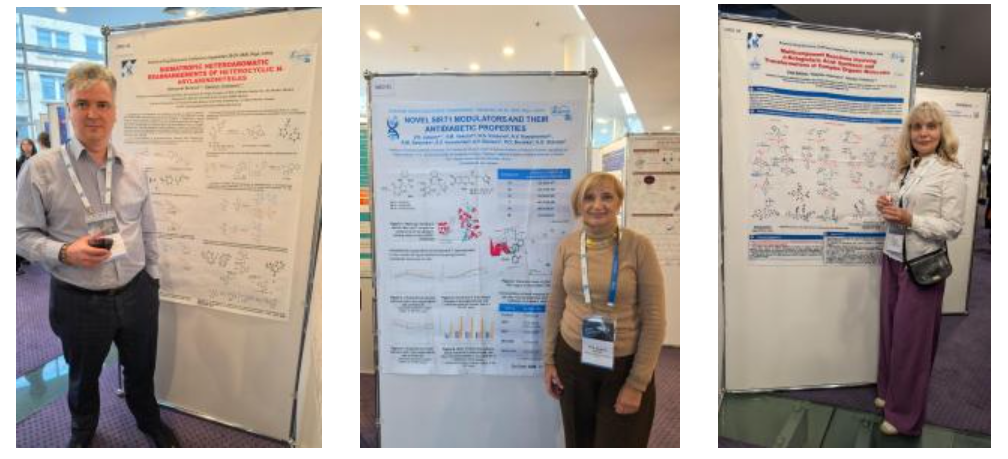
The posters sparked numerous scientific discussions: participants discussed the results, asked questions, shared their experience, and identified new opportunities for future collaboration.
On September 24–25, Drug Discovery Conference 2026, organized by the National Institute of Research and Innovation of Latvia, was held in Riga.
Its program covered 11 areas, ranging from the chemistry of heterocyclic compounds and the discovery of antibacterial and anticancer drugs to nanomedicine, photopharmacology, neurodegenerative diseases, central nervous system pharmacology, and metabolic disorders.
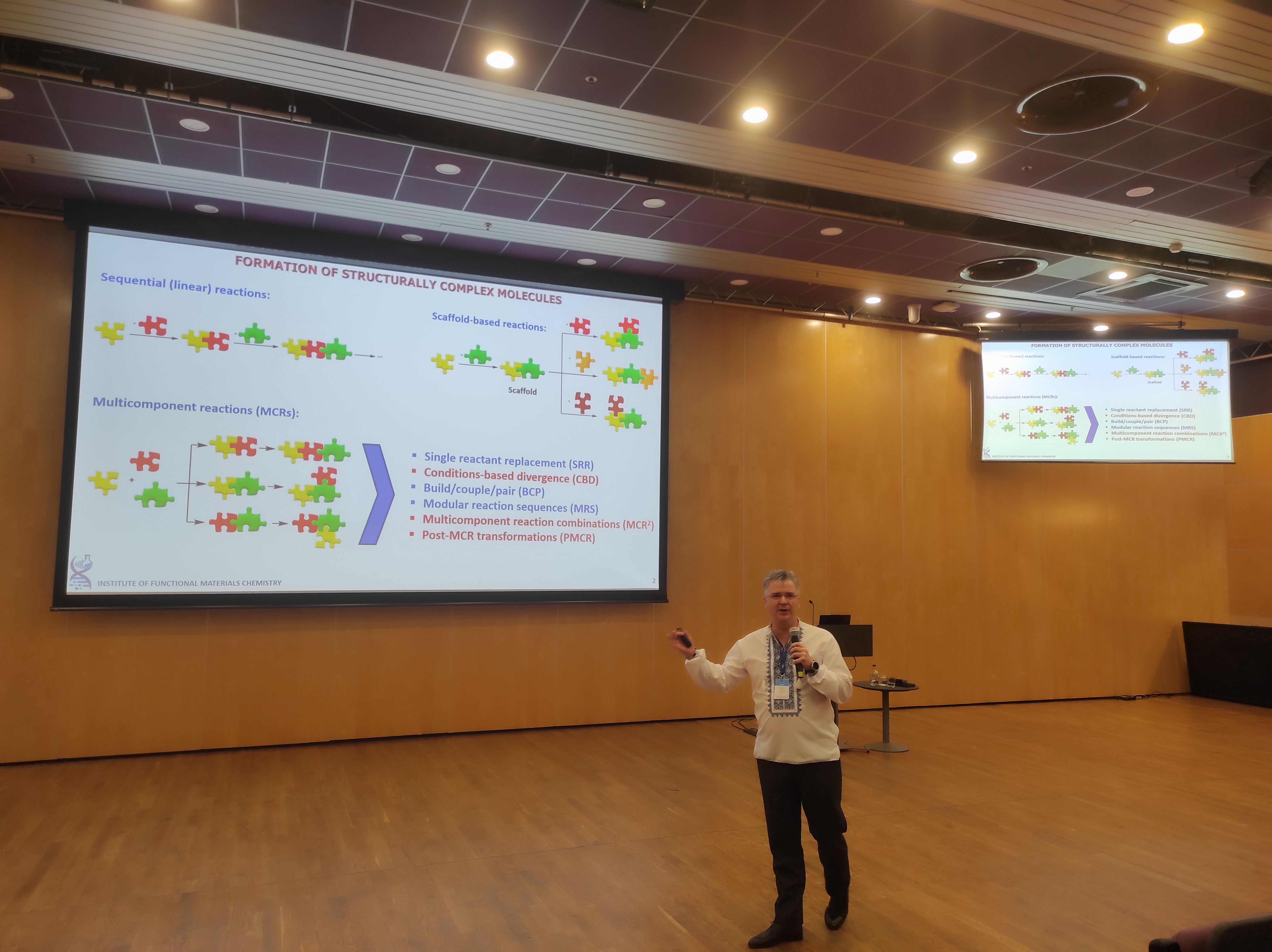
Valentyn Chebanov delivered an invited lecture in the heterocyclic chemistry session. Victoria Lipson presented the results of the search for SIRT1 inhibitors, while Yana Sakhno presented research findings on the synthesis of biologically active azoloazine systems.
In addition, academician Valentyn Chebanov was invited to join the jury responsible for selecting the best poster presentations at the conference.
The several days in Riga turned out to be much more than simply participation in two scientific events. They were an opportunity to meet longtime colleagues, make new professional connections, engage in scientific discussions, and talk about future research. The participants also discussed the further involvement of leading scientists from around the world in the Kharkiv Chemical Seminar — a project that continues to bring together Ukrainian and international chemists.
For Ukrainian science, which continues to operate amid a full-scale war, such professional connections are particularly important. They enable Ukrainian scientists to remain part of the international scientific community, present their research findings, maintain professional contacts, and discover new opportunities for collaboration.
After all, scientific collaboration often begins very simply: with a question asked beside a poster, a few minutes of conversation after a presentation, or a meeting with a colleague one has not seen for a long time.
That is what the September week in Riga became for SSI scientists — a time filled with research, meetings, and new ideas. And, as Valentyn Chebanov put it, a true “week of scientific excitement.”